Contact us

Millions of tons of crucial crops are being grown in Ukrainian regions occupied by Russia. The problem is that it’s hard to know exactly how much or where it’s really going.
It’s so tricky estimating volumes that some of the most prominent analysts are just cutting those regions held by Moscow out of forecasts altogether.
That’s because as the war grinds on, it’s getting harder to obtain reliable information about how much is being planted and harvested. And while some crops will be consumed in those territories, other amounts are being shipped to Russia or mixed in with Russian grain and sold on the world market.
But NASA’s food security and agriculture program gives a clue of the volumes. About 6.4 million tons of wheat — similar to Bulgaria’s total output — and almost 1.5 million tons of sunflower seeds were harvested in Russia-occupied regions of Ukraine this year, research using satellite imagery shows.
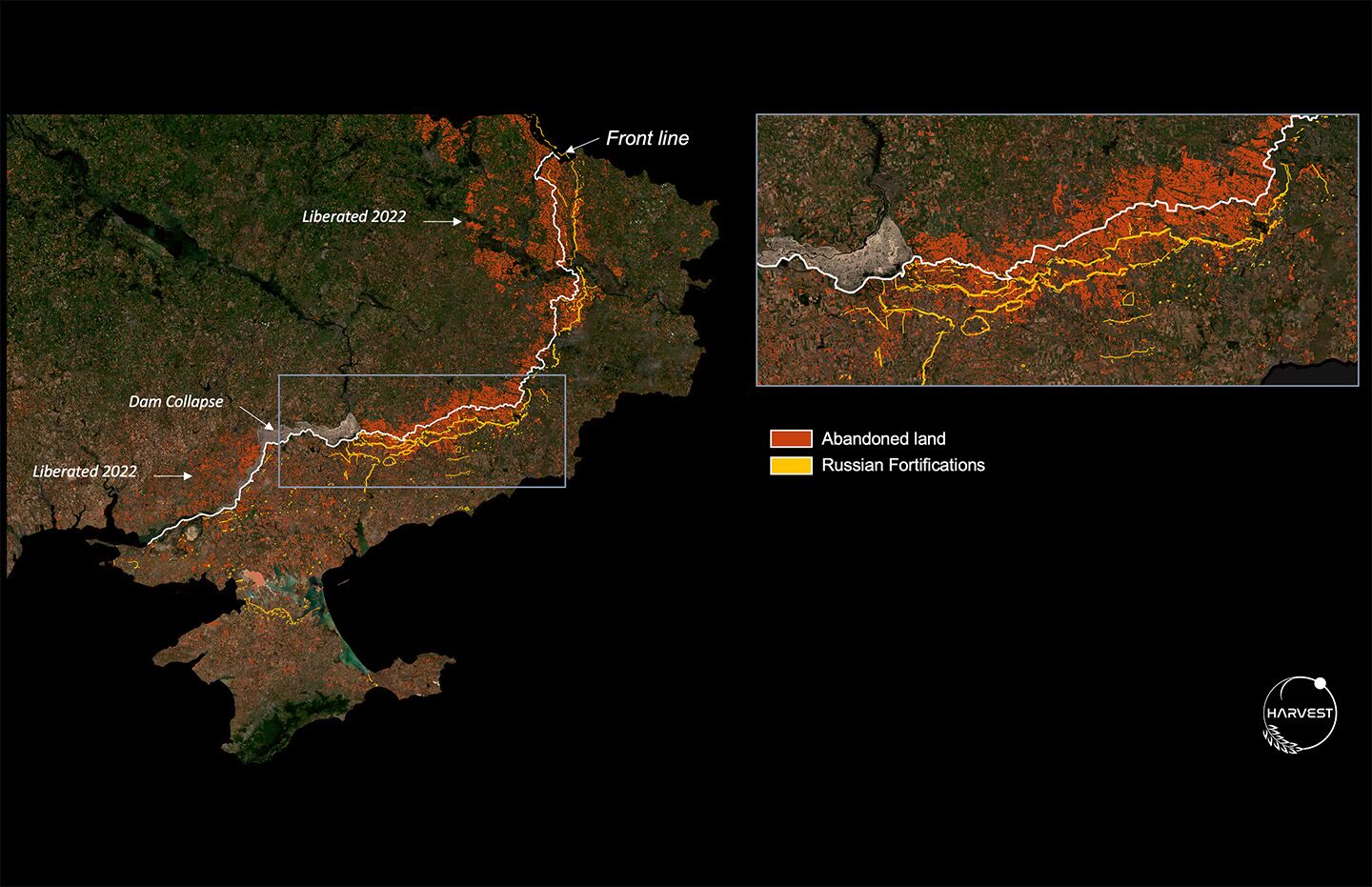
Satellite data show unplanted or abandoned fields in red, along the war’s front lines, July 2023.Source: Satellite data source: PlanetScope. Front lines from Institute for the Study of War and American Enterprise Institute’s Critical Threats Project. Analysis by Joseph Wagner, Shabrinath Nair, and Inbal Becker-Reshef.
Although not enough to tip the global balance, it’s a sizable amount unaccounted for in industry reports that traders use to gauge supplies and exports, which can affect market prices. Plus, inadvertently handling grain from occupied regions could raise legal risks for international merchants.
“We’re talking about a tremendous amount of grain,” said Inbal Becker-Reshef, program director at NASA Harvest. “It’s absolutely critical to have this information out there and transparent, and talking about how much food right now is being harvested and produced.”
Assessing the value and damage of grain grown on occupied land is also important for any claims Ukraine may make for reparations from Russia.
While NASA’s research doesn’t show how much of the grain grown there is being exported, it helps to indicate how much could potentially be mixed in with Russian cargoes, which head to nations including in the Middle East and Africa.
Ukraine’s Wheat Production Dropped a Third After Invasion
Loss of land to Russia has contributed to smaller harvests
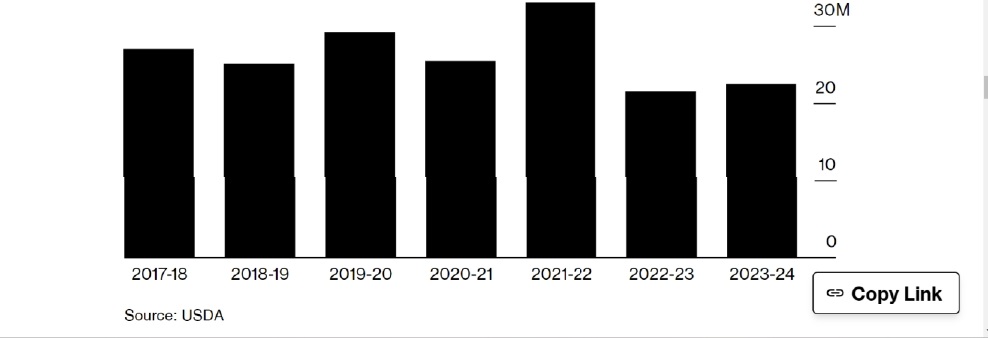
Organizations that forecast supplies face a dilemma on what areas to include. The US Department of Agriculture has said its estimates for Ukraine include Crimea but not other territories occupied by Russia.
The Agricultural Market Information System includes Crimea as part of the Russian Federation, but excludes the Russia-occupied territories of Donetsk, Zaporizhzhia, Luhansk and Kherson from both Russian and Ukrainian estimates, the United Nations’ Food and Agriculture Organization, which hosts the AMIS Secretariat, said by email.
Russian President Vladimir Putin this month said Russia’s total harvest would include 5 million to 6 million tons of grain from Kremlin-controlled regions of Ukraine, according to Interfax.
The amount could be even larger, according to the president of the Ukrainian Grain Association, who this month told Forbes that about 15 million to 16 million tons of all crops are produced in occupied areas. Ukraine’s agriculture ministry didn’t immediately reply to a request for comment.
“There is big uncertainty about the status of the Ukrainian agriculture in the occupied territories, including lack of reliable data to properly assess how much this area produces,” the USDA said by email.

A farmer harvesting wheat near in the Donetsk Oblast, Ukraine.Photographer: Miguel Medina/AFP/Getty Images
Another question is how much grain is being passed off as Russian. Switzerland’s top prosecutor last year warned traders to steer clear of foodstuffs reportedly pillaged from Ukraine or risk committing a war crime.
But reliably tracking grain supplies can be difficult, especially once it’s mixed with other origins. While big Western traders have opted to stop originating grain directly from Russian farmers, they can still handle cargoes from the top wheat shipper.
There’s currently a lack of checks on the origins of Russian exports, said Artem Svyryd, head of strategy and investment at Smart Holding.
“It’s not fair not to monitor the output,” said Svyryd, whose company holds a stake in agribusiness HarvEast, which lost a chunk of land to the invasion. “There should be still some verification from the international community and global institutions. Ukraine cannot do this on its own.”
The NASA Harvest research also shows that about 7% of Ukraine’s farmland was abandoned this year, mostly along the front lines. Becker-Reshef hopes the methods can help show how war and extreme weather impact production elsewhere in the world.
For Ukraine, “it’s extremely important that we’re transparent about those numbers,” she said. “It’s an area that we can’t ignore.”
— With assistance from Kateryna Chursina, Olesia Safronova, and Gina Turner
© Association of producers,
Processors and Exporters of Grain, 1997-2026.
When quoting and using any materials
reference to the Ukrainian Grain Association is obligatory.
If you use the Internet, you must also use
the hyperlink to https://uga.ua
 Site development
To register on the website, please contact the administration UGA admin@uga.ua